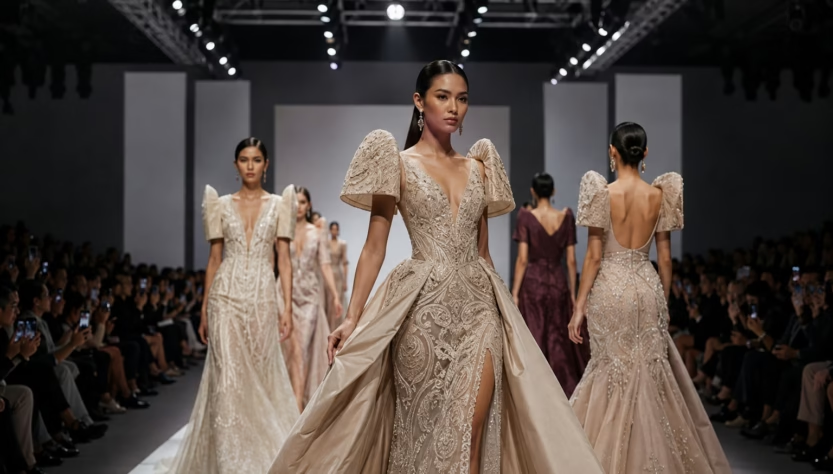
Beyond Slow Luxury: The Circular Economy Shift
While slow luxury emphasizes craftsmanship and heritage, a parallel movement in Philippine fashion is focused on circular economy principles. Upcycling, zero waste pattern cutting, and ethical production are no longer niche experiments; they are core strategies for brands seeking access to European markets where sustainability regulations are tightening. Filipino designers are uniquely positioned to lead this shift because their production model is already small-scale, handmade, and deeply connected to local communities.
Rags2Riches and the Social Enterprise Model
Rags2Riches (R2R) has become a benchmark for sustainable fashion in the Philippines. The brand partners with artisan communities in Payatas and other low-income areas to create high-quality bags, accessories, and garments from upcycled fabric scraps and indigenous materials. R2R’s products are now sold in international online platforms and have been featured in European sustainable fashion showcases. The brand’s success proves that ethical sourcing and commercial viability are not mutually exclusive.
Zero Waste Pattern Cutting and Deadstock Recovery
A new wave of young Filipino designers is adopting zero waste pattern cutting, a technique that eliminates fabric waste during garment production. Some have also started recovering deadstock fabrics from large manufacturers, turning surplus materials into limited-edition collections. These practices reduce environmental impact while creating unique, one-of-a-kind pieces that appeal to eco-conscious consumers. European buyers, in particular, are increasingly looking for garments with documented supply chain transparency and low carbon footprints.
Regulatory Pressure from the European Union
The European Union’s upcoming Extended Producer Responsibility regulations and stricter textile waste directives are pushing global brands to seek sustainable sourcing partners. Philippine artisanal producers, with their inherent small-batch methods and community-based labor, align well with these new standards. A 2026 Ellen MacArthur Foundation report on circular fashion highlights Southeast Asia as a key sourcing region for upcycled textiles, with the Philippines among the top three countries for artisanal recycling initiatives Ellen MacArthur Foundation. This external validation is opening doors for Filipino brands in premium European retail.
Challenges and Opportunities in Scaling Ethically
Scaling sustainable fashion without compromising ethics remains a challenge. Artisanal production is slow, and meeting international order volumes requires careful planning. However, some Philippine brands are solving this by forming cooperatives that pool resources, share production facilities, and maintain quality standards. Technology also plays a role: blockchain-based traceability platforms allow brands to prove the origin of materials and the fair treatment of workers, building trust with European consumers who demand accountability.